THE VIEWER? The Actual Purpose of Art
English, hardcover, 23 x 28 cm, 220 pages, 60 color reproductions.
Published by Salon Studio Ilgen, Germany, 2022. ISBN 978 3 00 072728 3
This publication has been realized thanks to a collective effort of financial and other support from the Tagore Foundation (USA), the Gabarrón Foundation (Spain), the Gifted Art Foundation (Netherlands), artists, collectors, art lovers, and art dealers from Egypt, Germany, Hong Kong, Japan, Korea (ROK), the Netherlands, Switzerland, Canada, Spain, the USA (New York, California, DC), India. All artists are especially thanked for waiving their copyrights for this publication. Plus, thanks to the staff at picture databanks bpk, RMN, and Scala for their professional help getting all pictures from various museums. Special thanks to François Blanchetière (musée d’Orsay), musée Rodin, musée Bourdelle, The Phillips Collection, Landau Fine Art, Pace Gallery, Ivo Bouwman Fine Art, The Ulla and Heiner Pietzsch Collection, for their kind assistance getting the right pictures.
Key notions: eye movements, alignment, familiarity, the focus of attention, bewilderment, the brain’s need for stress and decline of stress, well-being, health, private environment, and corporate social responsibility.

The Breish Collection of Modern and Contemporary Arab Art
AbdulMagid Breish describes his journey, how he became an art collector, and his passionate belief that any collector bears a cultural responsibility to support his regional and local art scene: in his case, the Arab world and Libya. Breish also offers a frank assessment of the pitfalls of investing in art worldwide, where provenance issues can often arise. Yet, he describes how building connections within the art can mitigate this. From auction houses to galleries to the artists themselves, he is especially keen on fostering relationships to increase personal involvement. In his case, his friendship with various artists has led to commissioning artworks directly and inspiring artistic practice indirectly. Breish’s approach is novel, yet it provides young collectors with an alternative strategy for collecting and offers advice on what to look out for and avoid, as well as how to progress within the stages of collecting to become a full-fledged patron of the arts.

A History of Arab Graphic Design – Bahia Shehab and Haytham Nawar
PROSE AWARD WINNER, ART HISTORY & CRITICISM
The first-ever book-length history of Arab graphic design
Arab graphic design emerged in the early twentieth century out of a need to influence and give expression to the far-reaching economic, social, and political changes that were taking place in the Arab world at the time. But graphic design as a formally recognized genre of visual art only came into its own in the region in the twenty-first century and, to date, there has been no published study on the subject to speak of.
A History of Arab Graphic Design traces the people and events that were integral to the shaping of a field of graphic design in the Arab world. Examining the work of over eighty key designers from Morocco to Iraq, and covering the period from pre-1900 to the end of the twentieth century, Bahia Shehab and Haytham Nawar chart the development of design in the region, beginning with Islamic art and Arabic calligraphy and their impact on Arab visual culture, through to the digital revolution and the arrival of the Internet. They look at how cinema, economic prosperity, and political and cultural events gave birth to and shaped the founders of Arab graphic design.
Highlighting the work of key designers and stunningly illustrated with over 600 color images, A History of Arab Graphic Design is an invaluable resource tool for graphic designers, one which, it is hoped, will place Arab visual culture and design on the map of a thriving international design discourse.

View From the Inside: Contemporary Arab Photography, Video and Mixed Media Art
Karin Von Roques
View From Inside is an expansive presentation of contemporary Arab photography, video, and mixed media art from the Middle East and North Africa. The book shows the works of 49 leading Arab artists from 13 different countries. The works reflect the emergence of photographic, video and digital art as important forms of creative visual expression in the Arab world since the 1990s. The artworks address a broad range of issues that the artists themselves have defined as important to the modern Arab experience. Four texts cover the early appearance of photography in the Middle East and North Africa in the mid-nineteenth century through photography’s evolution as an integral part of the contemporary Arab art world: The author of the lead essay on contemporary photographic art is the pioneering curator and expert on classical Islamic art and contemporary Arab art, Karin Adrian von Roques. Ms. von Roques has worked in the Middle East for more than twenty years, bringing important contemporary Arab art to museum audiences in Europe, Asia and the United States. Essays on the history of Arab photographic expression have been written by Samer Mohdad, a well-known Lebanese photographer, writer and co-founder of the Fondation Arabe pour l’Image in Beirut. Dr. Claude W. Sui, Senior Curator of the Forum International of Photography at the Reiss-Engelhorn Museum in Mannheim, Germany, and curator of exhibitions on nineteenth-century photography in Arabia including To the Holy Lands: Mecca and Medina to Jerusalem. Mona Khazindar, Director General of the Institut du Monde Arabe in Paris looks at the development of the history of modern Arab photography and its relationship to contemporary art. Wendy Watriss, Senior Curator and Artistic Director for FotoFest International provide a philosophical overview of the book in her introduction.

The Present Out of the Past Millennia: Contemporary Art from Egypt
Karin Von Roques
Egypt! The word alone conjures up images of art and history more than 4,000 years old: the beautiful Neferttiti, the treasures of Tutankhamun, the pyramids in the Valley of the Kings. Much of the culture of Europe has its roots in this fertile land on the Nile. But few people are aware of the vibrant contemporary art scene in today’s Egypt. This book introduces readers to 13 Egyptian artists working in a variety of media, struggling to reconcile the conflicting demands between the Oriental and Occidental world. The text discusses the intensive, often controversial discussion playing out in the contemporary art world in today’s Egypt.

Egyptian Hyperreal Pop: The Rise of a Hybrid Vernacular – Khaled Hafez
In the 90s in Egypt, an artistic vernacular style was defined by urban artists that attempted to bridge the gap between Eastern and Western mores and values as transmitted by visual culture. Their approaches and techniques used a hybridized version of East-West visual motifs that questioned the underlying assumptions of consumer culture that had arrived with the flood of Western advertising at the same time as it defined its own homegrown aesthetics. This book studies the photo-based works of three Egyptian contemporary visual artists Sabah Naim, Hazem Taha Hussein, and Nermine Hammam, and questions the influence of practicing photo-documentation and advertising techniques on their personal visual production. The three artists were born and educated in Egypt, and currently live and work in Cairo, Egypt, and the three of them have exhibited internationally in the past decade.

Artist?: The Hypothesis of Bodiness: A New Approach to Understanding the Artist and Art
Many clichéd simplifications exist, but what is an artist, and what causes the experience we qualify as the experience of art? Fré Ilgen explores the history and various fields of science to find out why humans need art.
In his previous book ‘ART? No Thing! Analogies between art, science, and philosophy artist and art theorist Fré Ilgen dealt with artists’ interest in exploring human reality, emphasizing the experience of art evolving between the viewer and the artifact. Renowned art critic Donald Kuspit wrote about this book: ‘Fré Ilgen’s Art? No Thing! is the most important publication by an artist since Kandinsky’s On The Spiritual in Art (1912).’
‘ARTIST?’ offers familiar, surprising, and revolutionary insights into the complex self of the artist and the experience provided by works of art, arguing that the biological processes involved in creating and encountering the artwork play a more critical role than till now have been acknowledged. Ilgen questions innovation and unidirectional progress in art and discusses the various struggles in art, including insecurity and mediocrity, emphasizing the natural importance of imperfection. He strongly criticizes the cliché about the experience of art being only a cerebral or only a retinal perception and promotes the concept of the whole mind/body perception. Discussing a large selection of artists across times and cultures, Fré Ilgen demonstrates the naturalness of artists proceeding from a virtuoso phase to maturation.
The hypothesis of BODINESS is a new philosophy of the creation and experience of art, arguing we do not only and merely consciously decide what we wish to create or look at because the human organism, the mind/body, sets perimeters for the creation of an experience offered by artworks. Bodiness does not have the body as a subject but the involvement of the (mind/)body in everything we do, think, or experience.
‘ARTIST?’ does not offer final answers but asks many profound questions, encouraging each reader to think for him/herself. Well researched and an approach much needed to stimulate the multi-disciplinary discourse on the naturalness of the human need for art. An approach that should stir all art students, artists, and other art professionals, as well as encourage art lovers, medical doctors, scientists, and maybe even politicians to reconsider their interest in art as a natural phenomenon of human beings, necessary in everyday life, and as an essential part of well-being that reaches beyond mere cultural expression or commodity.

Modern Egyptian Art: 1910-2003
Liliane Karnouk | Hardcover – April 1, 2005
From the early years of the twentieth century, with the rejection of European political and cultural domination in Europe, modern artistic expression in Egypt was influenced by and often reflected the country’s growing national consciousness. In the years following the 1952 revolution, wealthy patrons of the arts disappeared from Egypt’s cosmopolitan art world and were replaced by the state, which by the 1960s exercised full control over all cultural activities, including the arts. In the 1990s, as elsewhere throughout the world, Egyptian art was affected by general shifts in culture brought about by globalization. The disruption of a sense of place and feelings of belonging were a response to the influx of the challenging and, at times, disquieting information available to whole cultures and communities through new media.
Examining the work of over 70 artists from 1910 until the present day, Liliane Karnouk traces the parallel steps of modern Egyptian art and the social and political environment in which that art was and continues to be created. Fully illustrated with over 280 black-and-white and color illustrations, this comprehensive volume is both a feast for the eyes and a mine of information for artists and non-specialists alike.
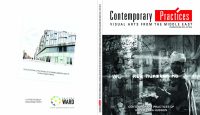
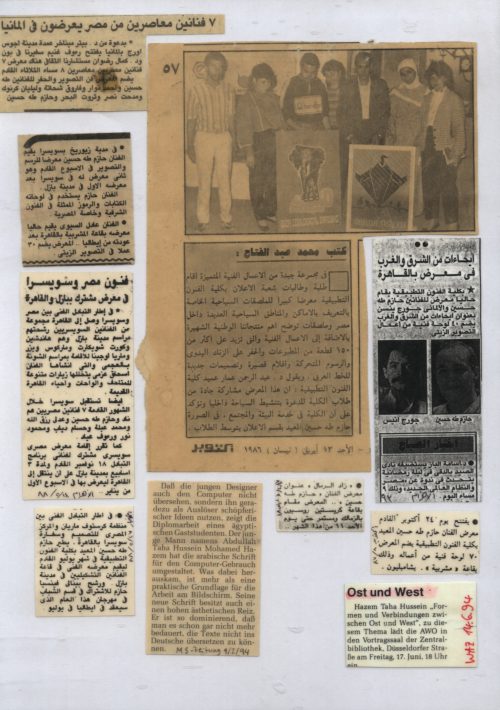
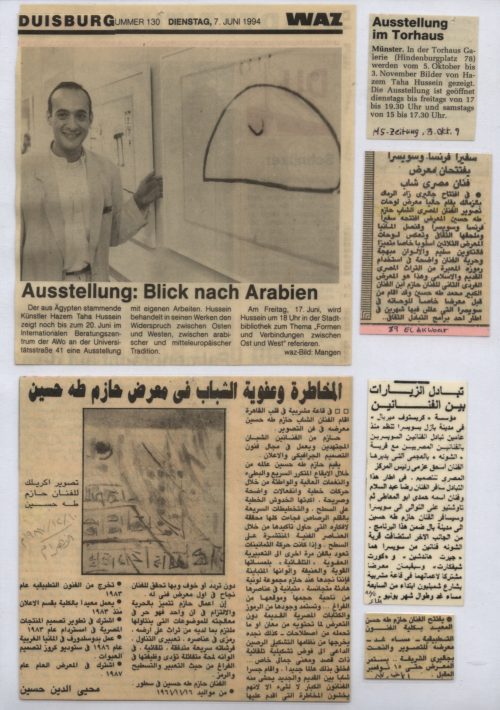
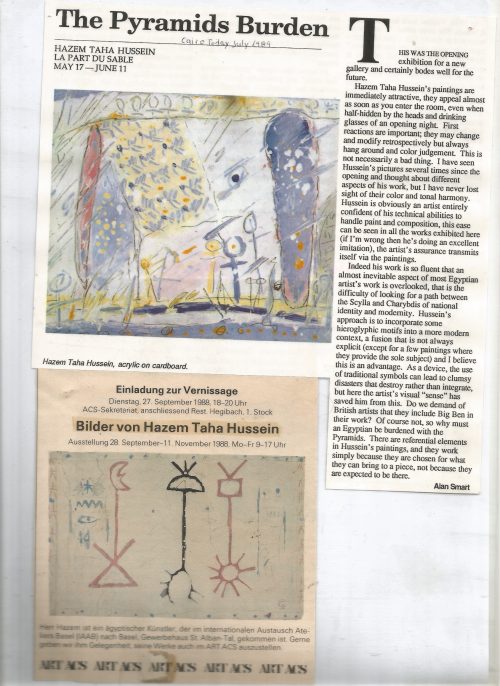
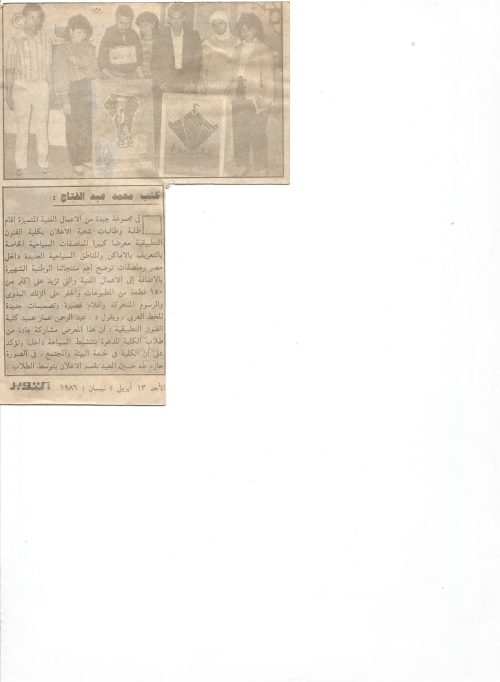
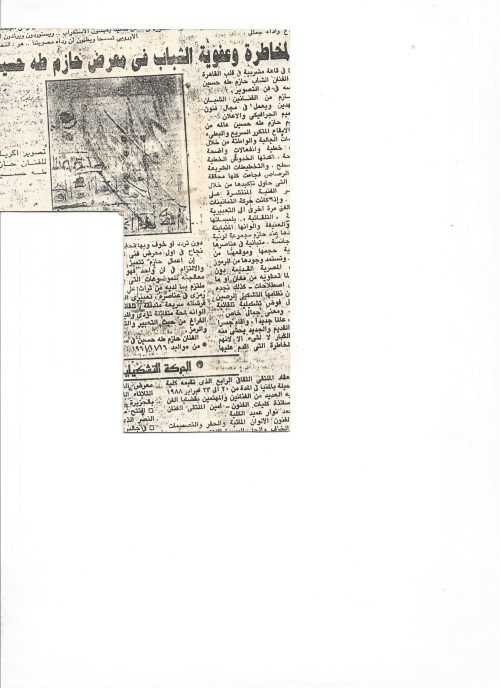
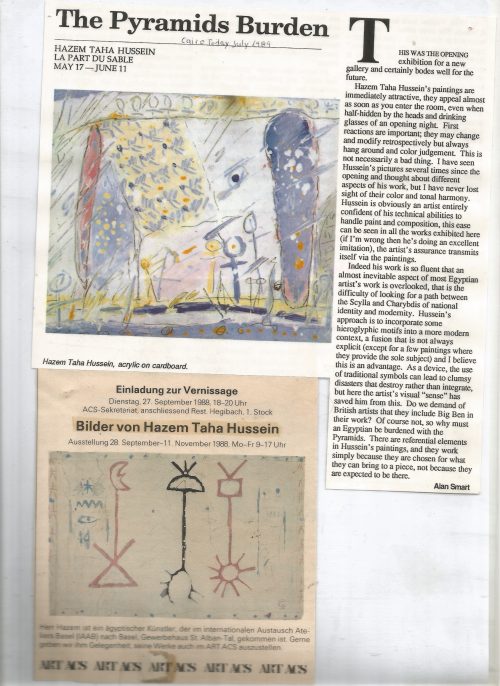
Contemporary Practices of Hazem Taha Hussein: By Marwa Mady
Hussein’s childhood and youth were exciting, such as traveling almost yearly to Europe and listening in his father’s home to discussions about Enlightenment, Culture, Aesthetics, etc. At six, young Hussein was surrounded by art books, freshly made sketches, unglazed ceramics, unfinished paintings, sculptures or video installations, objects, photography, prints, etc. Most of the Artworks were produced by Egyptian and German artists.
As a college student, he got to know – first in Egypt and later in Germany- the Zero group Artist Günter Uecker, Dr. Herbert Reckmann, the theorist and director of Folkwang Museum in Essen, Dr. Dieter Honisch, the director of the West-Berlin Nationalgalerie, the abstract geometric artist Karl Pfahler, Thomas Link and Bernd Damke. In 1989 Hussein had for three months an artist’s residence in Basel. He used to travel to Paris to meet his friends and visit museums during his stay. His studio apartment in the Foundation Christoph Merian was directly behind the Basel Museum of Modern Art, where he saw for the first time the work of the informal artist Antoni Tapies and the Kenitc Artist Tangli. Hussein didn’t react immediately toward the informal style. Still, he gained a better understanding of the aesthetics of the artwork of the informal Iraqi artist Shaker Hassan Al-Saied and the collage of Muneer Kanaan. During his stay in Germany between 1990 and 1998, he finished his diploma in visual communication design at Muenster WF. After obtaining his Ph.D. in Design philosophy from Wuppertal in 1997, he moved to Cairo at the beginning of 1998 and was based in Egypt till 2009. From 2009 till today, he has worked in Bahrain as an Associate Professor of visual communication design, contemporary visual art, and visual semiotics.